


How Does Mineral Oil Age Inside a Load Tap Changer?
- Knowledge Center
- Articles
- Load Tap Changer
- How Does Mineral Oil Age Inside a Load Tap Changer?
This article is Part 1 of a seven-part series on testing insulating liquids in load tap changers. Here we will address how mineral insulating oil ages inside an LTC, with a focus on the polymerization and film-formation mechanism that distinguishes LTC aging from aging in other oil-filled equipment. In Part 2, we will cover the conditions that accelerate filming inside an LTC.
Load tap changers (LTCs) are among the most mechanically and electrically active components in a power transformer installation. Unlike sealed transformers, where oil degradation proceeds primarily through oxidation under relatively stable conditions, the interior of an arc-in-oil LTC is a chemically aggressive environment — one where a distinct and operationally significant aging mechanism dominates long before oxidative degradation becomes the primary concern. Understanding how oil ages in this environment is foundational to building an effective LTC condition monitoring program.
Why LTC Oil Ages Differently
The interior of an arc-in-oil LTC is characterized by elevated dissolved oxygen content and frequent transient arcing events as taps change under load. These conditions accelerate oxidation relative to what occurs inside a well-maintained, sealed transformer. However, oxidation is not the most operationally consequential aging pathway for LTC oil. A second and distinct mechanism — polymerization — proceeds concurrently and typically causes functional problems well before oxidative degradation reaches critical levels.
Oil Polymerization and Film Formation
As mineral insulating oil ages inside an LTC, it polymerizes and deposits a resinous, varnish-like film onto contact surfaces and the mechanical components of the device. To the naked eye, this film appears as a smooth, very dark coating that is frequently misidentified as carbon deposits or coking. The smooth, continuous texture distinguishes it clearly from the characteristically pebbly surface morphology of true coke deposits.
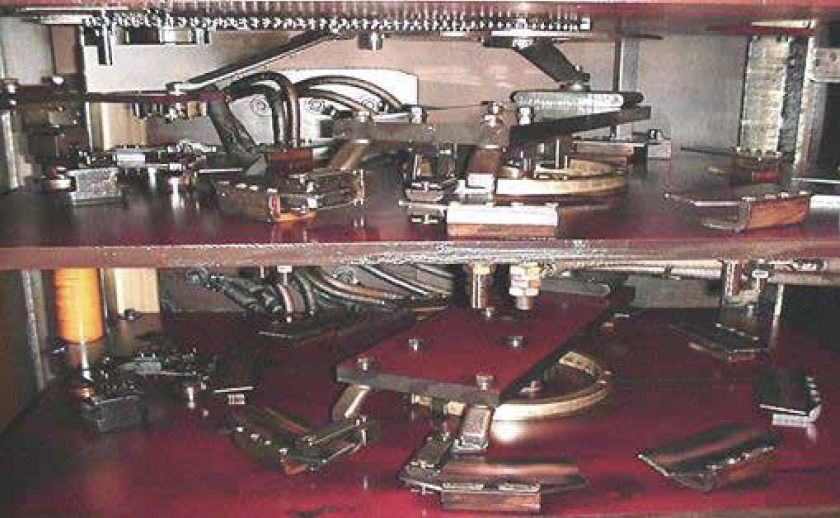
Photograph of filming compound deposits on LTC contacts, showing smooth dark film on contact surfaces and bright wiped areas of clean conductor.
Electrical and Mechanical Resistance
The film is both electrically and mechanically resistive. On contact surfaces, a heavy film layer reduces the efficiency of arc quenching by the insulating oil, causing arcs to be sustained longer on the contact surface. Prolonged arcing produces localized hot-spot overheating, which accelerates contact wear. In severe cases, overheating can progress to contact failure.
Effects on Mechanism Operation
Film deposition on the LTC mechanism introduces additional friction to mechanical movement within the device. As a result, the LTC requires more energy to complete tap changes, and the duration of each tap change increases — further extending arc exposure on the contacts. The additional mechanical work generates heat, elevating the overall operating temperature of the device. In resistive-type LTCs, this extended transition time can cause resistors to overheat as well. In extreme cases, mechanism binding can occur, substantially increasing the risk of mechanical failure.
Coking as a Secondary Consequence
Overheating of contacts and the mechanism can lead to coking. Coke deposits are mechanically hard and disruptive to normal LTC operation. They interfere with contact seating, contribute to contact erosion, and generate abrasive particles that are incorporated into newly forming film. These particles increase the mechanical resistance of the film and accelerate wear on the contact surfaces and mechanism.
Particle Incorporation Into Film
Particles from multiple sources — wiped film, arcing byproducts, and mechanical wear — become suspended in the oil and are subsequently incorporated into film as it continues to form. The abrasive character of these particles, particularly metallic and carbon species, further compounds wear and mechanical resistance within the device. The interaction between particle generation and film formation is self-reinforcing: as filming advances, more particles are produced; as particle counts rise, filming accelerates.
Summary:
- LTC oil aging is driven by two mechanisms: oxidation and polymerization. Polymerization, which produces varnish-like film, typically causes operational problems before oxidation reaches critical thresholds.
- Film deposits on contacts reduce arc-quenching effectiveness, sustain arcing, and cause hot-spot overheating and premature contact wear.
- Film on the mechanism increases friction, extends tap change duration, elevates operating temperature, and can lead to binding and mechanical failure.
- Coking is a secondary risk driven by overheating; coke deposits are abrasive, disruptive to operation, and contribute to accelerated wear.
- Particle incorporation is self-reinforcing: suspended particles become embedded in new film, increasing its abrasiveness and mechanical resistivity.
- Understanding the polymerization-dominant aging pathway in LTCs is prerequisite to designing a meaningful condition monitoring and preventive maintenance program.
In This Series:
- Part 1: How Does Mineral Oil Age Inside a Load Tap Changer?
- Part 2: What Causes Accelerated Film Formation in LTCs?
- Part 3: How Are Liquid Screen, Moisture, and DGA Used to Monitor LTCs?
- Part 4: What Does Particle Count Distribution Reveal About LTC Condition?
- Part 5: What Can Analytical Ferrography Reveal About LTC Particle Sources?
- Part 6: How Is Particle Count Analysis Applied to Other Oil-Filled Equipment?
- Part 7: What Standards and Case Studies Define LTC Particle Analysis?