


When Should the Corrosive Sulfur Test Be Performed?
- Knowledge Center
- Articles
- Corrosive Sulfur
- When Should the Corrosive Sulfur Test Be Performed?
This is Part 2 of a three-part series on corrosive sulfur testing. Part 1 covered failure mechanisms and testing history. Here we will address the practical question of when corrosive sulfur testing is warranted — and which transformer characteristics should drive that decision. In Part 3, we’ll cover the mechanics of how the Corrosive Sulfur test is performed, the range of possible results, and recommended next steps if a sample is identified as Corrosive.
Using Failure Data to Guide Testing Decisions
The most reliable framework for determining when to test comes from examining the operating profiles of transformers that have actually failed due to corrosive sulfur. Units that failed share a consistent set of characteristics, and understanding those characteristics allows for a risk-stratified approach to testing.
Transformers that have failed due to corrosive sulfur were generally manufactured since around 2000 and exhibited at least some of the following:
- Top oil temperatures ≥ 70°C for at least six months per year — This is the single most important screening criterion. Units operating this warm tend to be generator step-ups (GSUs) or transformers located in tropical or high-ambient-temperature environments.
- High load operation and/or elevated electrical stress — Units running near or at capacity are more susceptible.
- Sealed construction with low dissolved oxygen — Higher dissolved oxygen levels appear to offer some protection against corrosive sulfur attack on copper windings; sealed units with low O₂ lose this buffer.
- Unvarnished copper coils — Varnish provides a physical barrier that shields conductors from direct contact with corrosive sulfur compounds.
- Oil formulated without metal passivator — Metal passivators are additives that react with metallic surfaces to form a protective layer, inhibiting corrosive attack.
| Risk Factor | Significance | Criterion |
| Top oil ≥ 70°C for ≥ 6 months/year Triggers thermal decomposition of unstable sulfur compounds | Most important single factor | Primary |
| High load / high electrical stress Elevates operating temperature and accelerates degradation | Compounds thermal risk | Secondary |
| Sealed unit / low dissolved oxygen Higher O₂ appears to protect copper windings from corrosive attack | Removes natural buffer | Secondary |
| Unvarnished copper coils Varnish provides a physical barrier against corrosive sulfur compounds | Direct exposure risk | Secondary |
| No metal passivator in oil Passivators form a protective layer on metal surfaces, inhibiting attack | No chemical protection | Secondary |
Transformer must also have been manufactured or retrofilled since approximately 2000
Primary Testing Guideline
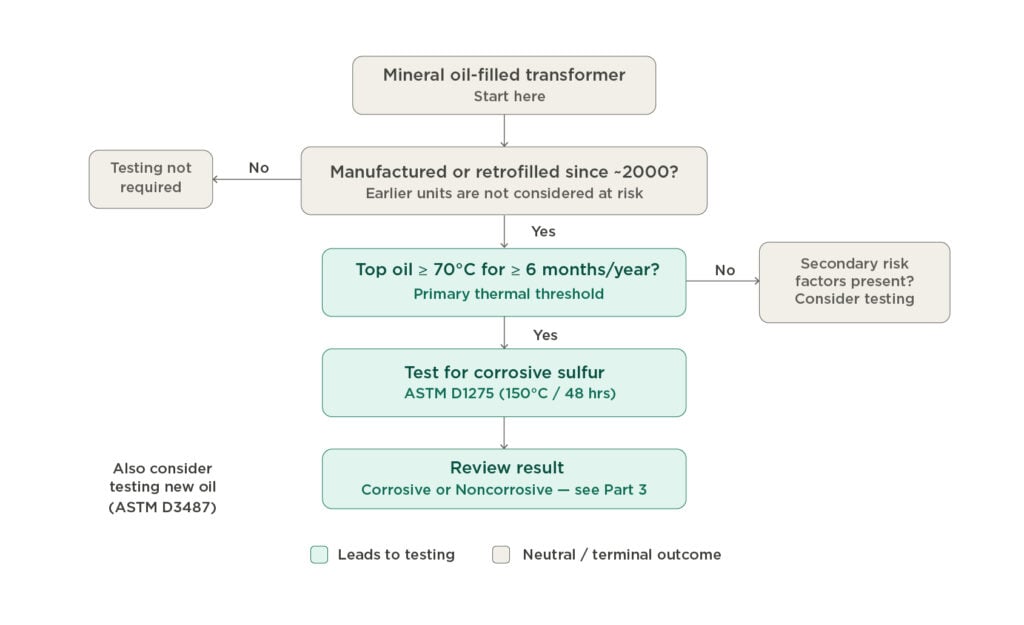
As a general guideline, corrosive sulfur testing is recommended for any mineral oil-filled transformer that meets both of the following conditions:
- Manufactured or retrofilled since approximately 2000
- Operates with top oil temperatures at or above 70°C for a minimum of six months per year
Units meeting both criteria carry the highest risk profile based on documented failure data and should be prioritized for testing.
Additional Cases That Warrant Testing
Transformers That Partially Meet the Risk Profile
Some transformers may not fully satisfy the temperature threshold but still present elevated risk based on other characteristics. Furnace transformers are a relevant example: they do not always reach 70°C top oil temperature for six months of the year, but their critical service role and exposure to high electrical stress make corrosive sulfur testing advisable — provided they were manufactured or retrofilled since around 2000.
When one or more risk factors are present even without the primary temperature criterion, testing should be considered on a case-by-case basis.
Insurance and Facility-Critical Applications
Some insurers require corrosive sulfur testing for main transformers serving industrial facilities. The criticality of these assets — and the potential cost of unplanned failure — often justifies testing independent of whether the unit strictly meets the primary guideline.
New Oil for Filling or Top-Off
Corrosive sulfur testing is also applicable to new oil intended for filling or topping off a transformer. ASTM D3487, Standard Specification for Mineral Insulating Oil Used in Electrical Apparatus, includes the Corrosive Sulfur test (ASTM D1275) among its required qualification tests for new mineral insulating oil.
Summary:
- The strongest single indicator for corrosive sulfur testing is top oil temperature — transformers running at ≥ 70°C for at least six months per year and manufactured or retrofilled since ~2000 should be tested.
- Additional risk factors — sealed construction, low dissolved oxygen, high electrical stress, unvarnished coils, and oil without metal passivator — can warrant testing even when the temperature threshold is not fully met.
- Furnace transformers are a notable exception to the temperature rule: their critical nature and high electrical stress justify testing regardless of typical operating temperature.
- Insurance requirements and facility-critical designations may independently trigger the need for corrosive sulfur testing.
- New oil intended for transformer filling or top-off should also be tested — ASTM D3487 includes ASTM D1275 among its qualification requirements for new mineral insulating oil.