


How Does Hot Oil Cleaning Extend Transformer Life?

- Knowledge Center
- Articles
- Hot Oil Cleaning
- How Does Hot Oil Cleaning Extend Transformer Life?
This article addresses the hot oil cleaning process — including how oxidation products are removed, how treated oil is recirculated through transformer windings, and how the process slows insulation degradation to extend transformer service life.
Transformer oil doesn’t just insulate — it protects. When oil oxidizes, the decay products it generates become chemically aggressive to the cellulose paper insulation surrounding the windings. Left unaddressed, this accelerates depolymerization of the insulation, reducing its mechanical strength and shortening the operational life of the transformer. Hot oil cleaning, performed using a mobile oil processing unit (VOP) with a filtering clay such as Fuller’s Earth, is the most widely recommended service intervention when oxidation has advanced to a damaging level. The process reclaims the oil chemically and uses the treated oil as a solvent to extract oxidation byproducts from the insulation itself.
There are three steps in hot oil cleaning:
What Hot Oil Cleaning Removes
The oxidation products targeted by hot oil cleaning include acids, alcohols, peroxides, aldehydes, and both dissolved and suspended sludges — collectively referred to as polar contaminants. These compounds cannot be removed by filtration or vacuum purification alone. Removing them requires a chemical adsorbent such as Fuller’s Earth or activated alumina, which binds polar molecules as oil passes through the processing rig.
It is worth clarifying terminology here, as significant confusion exists in the industry. Per IEEE Standard 637, the correct term for this chemical removal process is “reclaiming” — not “filtering.”4 Filtering and vacuum purification fall under the category of “reconditioning,” which addresses moisture, gases, and particulate matter but does not remove polar oxidation products. In regions where IEC standards govern, reclaiming is often referred to as “regeneration.”
Some reclaiming technologies — particularly those that do not reactivate the adsorbent — can introduce moisture into the treated oil as a byproduct of the process. Moisture content must be monitored and controlled throughout; a typical target is to maintain oil moisture below 15 ppm as it exits the purifier. The threshold is voltage-dependent, and responsible operators will have instrumentation or oil testing capability on-site to verify compliance continuously.
Recirculating the Treated Oil
Why temperature matters: the aniline point
Once reclaimed, the clean oil is returned to the transformer at controlled flow rates and temperature. When heated to its aniline point — typically 65–80 °C — transformer oil becomes an effective solvent for its own oxidation decay products. At this temperature, recirculating oil through the windings does more than restore oil quality; it actively extracts sludge deposits from the paper insulation itself, reversing some of the contamination that has migrated into the insulation over time.
Determining the number of passes
Multiple recirculation passes are typically required to achieve thorough cleaning. The number of passes depends on two variables: the degree of oxidation present in the oil and the duration that the transformer has been operating in a contaminated state prior to service. More severely degraded systems require more cycles to achieve acceptable cleanliness.
A critical operational requirement is that each pass must be performed while the clay filtering media remains active — not “spent.” Spent clay loses its adsorptive capacity and will no longer remove polar contaminants effectively. Monitoring the oil’s acid number during processing is the standard method for determining when to change or reactivate the filtering clay. Additionally, PCB content and oxidation inhibitor concentration should be evaluated and accounted for as part of the treatment plan.
How Oxidation Damages Paper Insulation
The mechanical strength of cellulose paper insulation decreases progressively as a transformer operates in service. Three conditions accelerate this degradation: excess oxygen, elevated moisture, and high operating temperatures. Clean, dry transformer oil provides a barrier against oxygen and moisture ingress, and serves as the primary heat transfer medium to cool the insulation during operation. As the oil degrades, its protective function diminishes — and its oxidation products actively attack the insulation.
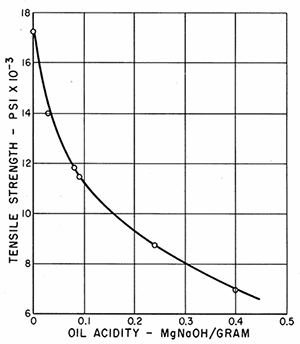
Frank M. Clark of General Electric was among the first researchers to quantify this relationship empirically. His laboratory experiments on oil/paper systems showed a clear correlation between oil acid number and paper tensile strength. New paper aged in new oil had an initial tensile strength of approximately 17,000 psi. When the oil acid number reached 0.15 mg NaOH/g (0.21 mg KOH/g), tensile strength had fallen to roughly 10,500 psi — a reduction of nearly 40 percent.3
Scanning electron microscopy evidence
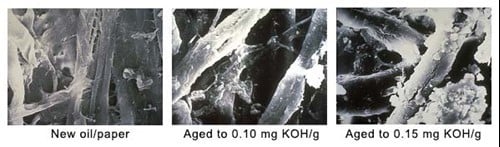
In the 1980s, SDMyers replicated and extended Clark’s work, aging oil/paper systems to an oil acid number of 0.15 mg KOH/g and examining paper samples at intervals using scanning electron microscopy at 750× magnification. The images show progressive structural degradation correlating directly with oxidation level — from intact fiber structure in new oil/paper samples to visible breakdown in moderately and severely aged specimens. The depolymerization of cellulose is irreversible; once mechanical strength is lost, it cannot be restored.
The Case for Proactive Maintenance
Hot oil cleaning removes the oxidation decay products in contact with the paper insulation and slows further depolymerization — but it cannot reverse damage that has already occurred. The practical implication is significant: the earlier maintenance is performed relative to the onset of oxidation, the more insulation life is preserved.
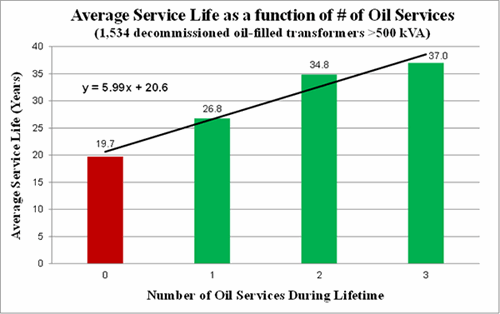
A 2014 CIGRE paper authored by SDMyers technical staff analyzed service history across more than 1,500 transformers.5 The study found that oil maintenance services — including hot oil cleaning, oxidation inhibitor restoration, and moisture reduction — extended transformer service life by an average of approximately six years per service event. This figure underscores the value of regular, proactive oil maintenance programs rather than reactive intervention after insulation damage has progressed.
Summary:
- Hot oil cleaning reclaims transformer oil using a VOP with Fuller’s Earth or activated alumina, removing polar oxidation products — acids, alcohols, peroxides, aldehydes, and sludges — that reconditioning alone cannot address.
- Terminology matters: Per IEEE Std. 637, the correct term for this chemical process is “reclaiming,” not “filtering.” Filtering and vacuum purification are reconditioning methods with a narrower scope.
- Heating oil to its aniline point (65–80 °C) enables it to act as a solvent, pulling oxidation decay products and sludge deposits out of the paper insulation during recirculation.
- The number of recirculation passes required depends on oxidation severity and how long the transformer operated in a degraded state; clay activity must be verified throughout via acid number testing.
- Tensile strength loss is irreversible: Research by Clark (GE) and SDMyers shows that oil acid numbers as low as 0.15 mg KOH/g correspond to a ~40% reduction in paper mechanical strength — damage that cannot be undone.
- Proactive maintenance pays: A CIGRE study of 1,500+ transformers found oil maintenance services extend service life by approximately six years per intervention, on average.
- The critical principle: Hot oil cleaning is most effective — and most protective — when performed before insulation degradation has advanced.
References:
1 IEEE Guide for Loading Mineral-Oil-Immersed Transformers and Step-Voltage Regulators, IEEE Std. C57.91-2011, March 2012.
2 M. Horning, J. Kelly, S. Myers, and R. Stebbins, Transformer Maintenance Guide, 3rd ed., Tallmadge: Transformer Maintenance Institute, 2004, pp. 53–71.
3 F. M. Clark, Insulating Materials for Design and Engineering Practice, New York: John Wiley and Sons, Inc., 1962, p. 283.
4 IEEE Guide For the Reclamation of Insulating Oil and Criteria for Its Use, IEEE Std. 637-1985, 1985.
5 R. Rasor, D. Roberts, and A. Shkolnik, “Transformer Reliability – A Statistical Look,” CIGRE Canada Conference, September 2014.