


Which Containers Should You Use for Transformer Oil Samples?
- Knowledge Center
- Articles
- Oil Sampling
- Which Containers Should You Use for Transformer Oil Samples?
This article is Part 3 of a three-part series on transformer oil sampling. Part 1 addressed the equipment data, nameplate information, and operational conditions required before submitting a sample for analysis. Part 2 covered the field practices that determine whether a sample is truly representative of internal equipment conditions. Here we will address sample container selection — including container types, their key characteristics, and specific requirements for Karl Fischer Moisture Analysis.
Container Selection Affects Result Accuracy
Proper sample collection and documentation mean little if the sample is stored or transported in the wrong container. Container type directly affects whether the sample reaching the laboratory reflects actual internal equipment conditions — or has been altered by permeation, contamination, or moisture exchange during transit.
ASTM D923 Appendix X2 provides a comprehensive reference for sample containers. The table below summarizes the most commonly used container types and their key characteristics. Use it as a field reference for matching container to test type.
Sample Container Types and Characteristics
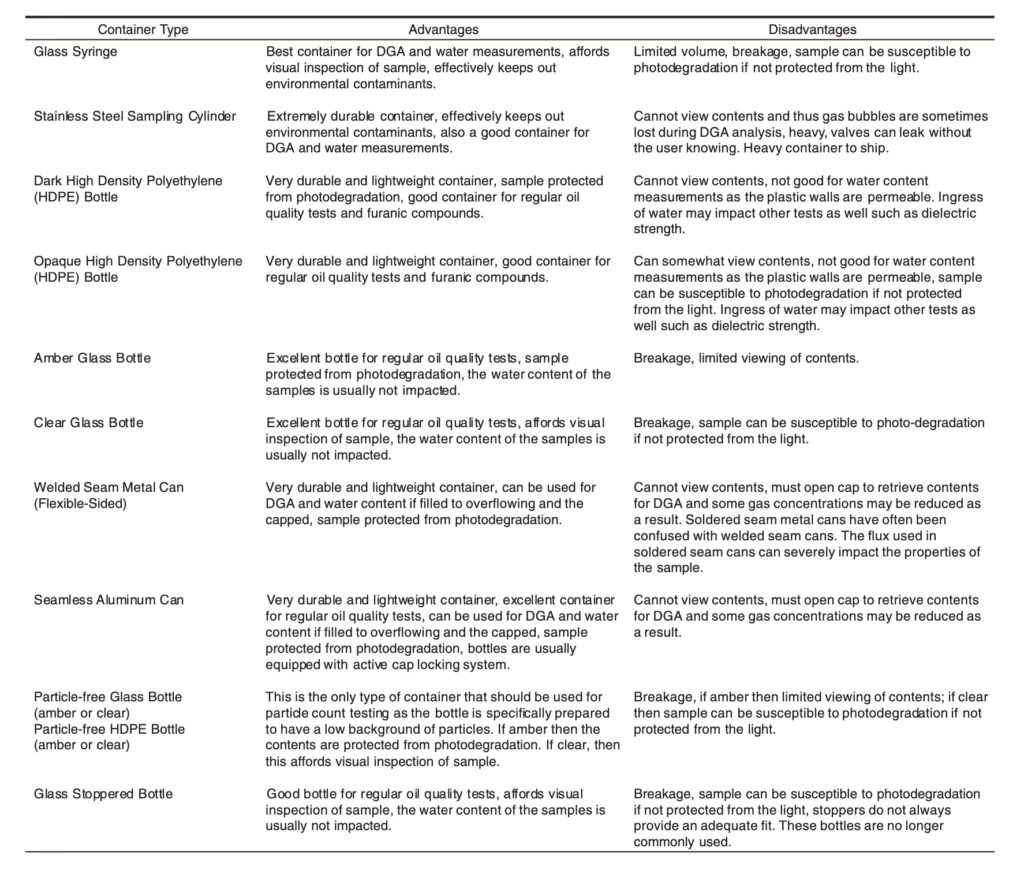
Source: ASTM D923-15(2023). Standard Practices for Sampling Electrical Insulating Liquids. Appendix X2. https://www.scribd.com/document/848025906/ASTM-D923-15-2023
Karl Fischer Moisture: Container Requirements
Karl Fischer (KF) Moisture Analysis is particularly sensitive to container handling. Moisture can be introduced or lost through permeation, headspace gas exchange, or exposure during sampling — any of which will compromise the result.
A glass bottle is an appropriate container for KF Moisture Analysis, but only when all four of the following conditions are met:
- Desiccant pre-conditioning — Prior to sampling, store the capped bottle with a desiccant tablet inside to keep the interior dry. Discard the desiccant tablet immediately before filling.
- Metal cap with Teflon liner — The bottle must have a metal cap fitted with a Teflon liner to ensure an airtight, non-reactive seal.
- Fill to capacity — Fill the bottle to the very top to minimize headspace. Residual gas space allows moisture exchange between the oil and the atmosphere inside the container.
- KF test performed first — The KF Moisture test must be the first analysis run from that bottle. The first time the bottle is opened after sampling should be for the KF test — not for a prior analysis that would expose the sample to ambient air.
If any of these conditions cannot be met in the field, use a container specifically designated for moisture analysis by your laboratory.
Summary:
- Container selection is the final variable in sample integrity — the wrong container can alter moisture content, dissolved gas composition, or introduce contamination before the sample reaches the laboratory.
- ASTM D923 Appendix X2 is the authoritative reference for a comprehensive container selection guide; the table above covers the most commonly used types.
- Karl Fischer Moisture Analysis requires strict container protocol — glass bottles are acceptable only when desiccant pre-conditioning, a Teflon-lined metal cap, full fill volume, and first-open testing sequence are all observed.
- Any deviation from KF container requirements risks introducing or losing moisture, producing results that do not reflect actual insulation system moisture content.