


How IR Thermography Caught a Hidden Cooling Failure
- Knowledge Center
- Case Study
- How IR Thermography Caught a Hidden Cooling Failure
During a routine transformer inspection, SDMyers performs infrared (IR) scanning, an effective complementary analytical method, to help a Michigan-based utility company avoid downtime.
Challenge: The Limits of Liquid Sampling
Committed to reliability-centered maintenance, an SDMyers utility customer in Michigan had nearly 30 years of annual transformer inspections and liquid sampling on record — a substantial diagnostic history by any measure. Dissolved gas analysis and other liquid-based tests remain among the most proven methods for evaluating transformer condition, providing early warning of thermal and electrical faults developing inside the unit.
But liquid sampling has a fundamental constraint: it cannot detect every failure mode. It evaluates what is dissolved or suspended in the oil; it cannot assess the mechanical or thermal behavior of external systems. Recognizing this gap, the customer sought a more comprehensive assessment of their transformer assets — one that could surface problems liquid testing alone would miss.
Solution: IR Thermography Added to Routine Inspection
SDMyers recommended integrating infrared thermography into the customer’s existing inspection schedule, performing the IR scan concurrently with routine liquid sampling. The combined approach offered two distinct advantages. First, it eliminated the need for a separate site visit, keeping the process operationally efficient. Second, and more importantly, it allowed SDMyers diagnosticians to interpret IR data alongside liquid test results, producing a single, integrated asset snapshot rather than two siloed reports. The additional data points enabled a more accurate and defensible condition assessment than either method would support independently.
What the Thermal Image Revealed
During the IR inspection, the thermographer evaluated the transformer’s radiator banks — the primary heat exchange system responsible for dissipating heat from the insulating liquid. A properly functioning radiator bank produces a smooth, decreasing temperature gradient from top to bottom, reflecting the downward flow of cooling liquid as heat is transferred to ambient air.
The thermal image told a different story. Rather than a graduated temperature profile, the entire radiator bank appeared uniformly cool — a thermal signature that indicates the liquid is not circulating through the radiator at all. This pattern is a recognized indicator of low liquid level, a condition that is invisible to dissolved gas analysis or other oil sampling methods, since those tests require liquid to be present and circulating in the first place.
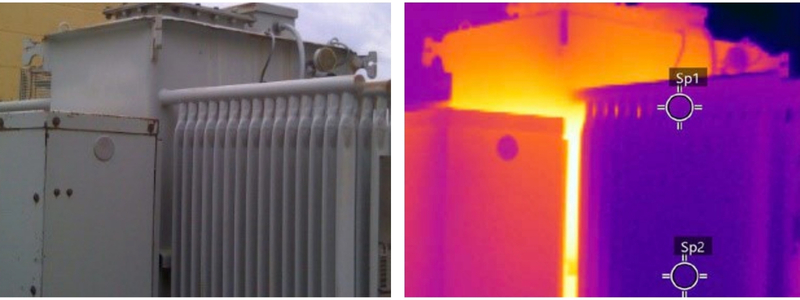
Transformer radiator — a comparison of conventional photography and a thermal image showing the lack of a temperature gradient with only a Delta of 0.6°C between Sp1 (22.4°C) and Sp2 (21.8°C).
Complicating Factor: Unreliable Gauge Readings
Under normal circumstances, low liquid level would also be flagged during a standard visual inspection of the transformer’s level and temperature gauges. In this case, however, both gauges had been showing irregular fluctuations across years and seasons — readings inconsistent enough that neither could be treated as reliable. Rather than confirming or ruling out the IR finding, the gauges introduced ambiguity.
The diagnostic conclusion was that at least one gauge was faulty and required replacement. This made the IR thermography data not just useful, but essential: it provided the only objective, instrument-independent evidence that the liquid level was genuinely low and that the radiator bank was thermally compromised.
Outcome: Confirmed Low Liquid Level, Prevented Failure
With IR thermography data supporting the assessment, the customer had the evidence needed to justify two corrective actions: a liquid top-off service to restore proper level, and gauge replacement to restore reliable visual monitoring. Neither action would have been defensible on gauge readings alone, given their documented inconsistency.
More significantly, acting on the IR findings allowed the customer to avoid a progression of failure modes that, left unaddressed, could have resulted in catastrophic equipment loss:
- Thermal degradation of the paper insulation — Oil overheating accelerates oxidation and breakdown of the cellulose insulation system, a process that is irreversible once underway
- Accelerated loss of transformer service life — Paper insulation condition is the primary determinant of overall transformer life expectancy; degraded insulation cannot be restored
- Flashover risk from exposed core and windings — Continued liquid loss below a critical threshold can expose energized components, creating conditions for electrical flashover and unplanned, potentially catastrophic failure
The case illustrates a core principle of reliability-centered maintenance: no single diagnostic method captures the full condition picture. Liquid sampling and infrared thermography are not redundant — they are complementary, each surfacing failure modes the other cannot detect. When integrated into a single inspection event and interpreted together, they produce an asset assessment that is materially more accurate and complete than either method provides alone.
Summary:
- Liquid sampling alone has diagnostic blind spots — it cannot detect mechanical or thermal anomalies in external systems such as radiator banks or cooling circuits.
- IR thermography identified a uniformly cool radiator bank — a thermal signature indicating the liquid was not circulating, consistent with low liquid level.
- Gauge unreliability complicated the diagnosis — irregular fluctuations in both level and temperature gauges made visual inspection inconclusive, elevating the diagnostic value of the IR data.
- IR data justified corrective action — the findings supported both a liquid top-off service and gauge replacement, neither of which could be confirmed through gauges alone.
- Three critical failure modes were avoided — thermal degradation of paper insulation, accelerated loss of transformer life, and potential flashover from exposed core and windings.
- The case reinforces a complementary diagnostic model — liquid sampling and IR thermography surface different failure modes; combining them in a single inspection event produces a more complete and defensible condition assessment.
Add IR Scanning to Your Routine Inspections
SDMyers recommends IR scanning in conjunction with liquid testing and visual inspection on transformers and other electrical equipment to provide a comprehensive snapshot of your asset’s condition. Performed simultaneously with liquid sampling on energized equipment with minimal disruption, IR scanning can provide a substantially clearer understanding of potential failure modes.
Contact us to learn more and partner with the experts in end-to-end transformer care since 1965.