


How IR Thermography Caught What DGA Missed In Main Tank

- Knowledge Center
- Case Study
- How IR Thermography Caught What DGA Missed In Main Tank
This case study demonstrates how infrared (IR) thermography identified a developing internal transformer deficiency that dissolved gas analysis (DGA) did not detect for an industrial customer in Pennsylvania.
Challenge: DGA Alone Has Diagnostic Limits
For most transformer operators, dissolved gas analysis is the cornerstone of a proactive maintenance program — and for good reason. DGA is sensitive, well-validated, and capable of detecting a wide range of developing fault conditions through changes in gas concentration and ratios. For a 7,500 kVA transformer serving an industrial facility in Pennsylvania, routine liquid sampling and DGA had been the primary condition monitoring method.
But DGA has boundaries. It detects gases produced by fault energy acting on oil and paper — thermal decomposition, partial discharge, arcing — but only when those processes have generated gases in quantities sufficient to dissolve into the oil at detectable levels. Some developing deficiencies, particularly in early stages, may not yet be producing a gas signature that registers as statistically significant against historical baseline data. Recognizing this limitation, and having designated this transformer a critical asset, the customer sought an additional preventive maintenance method that could extend diagnostic coverage beyond what liquid sampling alone could provide.
Solution: IR Scanning Added to Routine Inspection
SDMyers recommended integrating infrared thermography into the customer’s existing inspection schedule, performing the IR scan concurrently with routine liquid sampling. As with liquid testing, the value of thermography increases when its findings are interpreted in context — alongside DGA results, historical trends, and asset criticality. Conducting both methods during the same site visit ensured that data from each could be cross-referenced directly, and kept the additional inspection efficient from an operational standpoint.
Initial Scan: A Single Hot Spot on the Main Tank
The first infrared scan identified a potential deficiency. A hot spot was detected on the horizontal plane of the main tank — an area where temperature distribution should be relatively uniform under normal operating conditions. The finding did not rise to the level of immediate action, but it was anomalous enough to document and flag for follow-up. SDMyers included the thermal image in the inspection report and recommended that the area be re-examined at the next scheduled liquid sampling interval.
Follow-Up Scan: Progression to Multiple Hot Spots
At the next regular inspection, the thermal images showed clear progression. What had been a single hot spot had developed into multiple distinct hot spots across the same horizontal plane on the main tank. Temperature differentials in that region had increased substantially — where a variance of 1°C to 3°C is considered acceptable on the horizontal plane, this transformer was now exhibiting differentials ranging from 5°C to 16°C. That degree of thermal irregularity is not attributable to normal load variation or ambient temperature fluctuation. It indicates a localized condition inside the tank that is generating or retaining heat in an abnormal pattern.
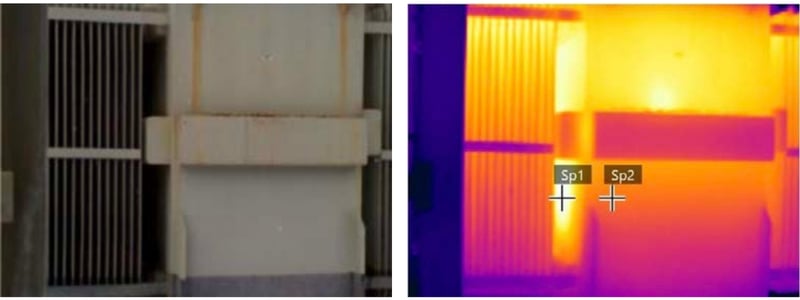
Main transformer tank — a comparison of conventional photography and a thermal image showing hot spots with a Delta of 16.2°C between Sp1 (41.2°C) and Sp2 (25°C).
Cross-Referencing IR with DGA Results
With a confirmed thermal progression in the IR data, SDMyers cross-referenced the findings against the concurrent DGA results, specifically looking for elevated levels of ethylene and other gases associated with thermal faults at moderate to high temperatures. Ethylene production typically increases as fault temperatures rise, making it a useful marker for distinguishing low-level thermal activity from more significant internal heating events.
In this case, the DGA results did not show significantly elevated gas levels relative to prior samples. There was no clear gas signature to independently confirm an internal fault. This is a diagnostically important outcome — not because it ruled out a problem, but because it demonstrated that DGA alone would not have triggered further investigation. Without the IR thermography data, the thermal progression occurring inside this transformer would have gone undetected within the routine monitoring program.
Outcome: Data-Driven Monitoring, Failure Risk Reduced
Because the DGA results did not confirm elevated fault gas activity, SDMyers did not recommend immediate intervention. Instead, the IR findings — combined with the absence of a confirming gas signature — supported a recommendation for continued close monitoring through both liquid analysis and thermography at defined intervals. The thermal progression observed across two consecutive scans provided objective justification for increasing monitoring frequency and documenting the asset’s condition trajectory.
For the customer, the value of that data extended beyond the immediate inspection cycle. Thermal imaging records showing progressive hot spot development on a critical asset constitute the kind of documented evidence required to justify further investigation — internal inspection, additional diagnostic testing, or long-term asset planning decisions — in operational and capital budgeting contexts where data-supported rationale is essential.
Acting on the IR findings also positioned the customer to avoid a failure progression that, left unmonitored, carries significant consequences for a critical asset:
- Thermal degradation of the insulating liquid — Sustained overheating accelerates oxidative breakdown of the oil, reducing its dielectric strength and its ability to protect the insulation system
- Accelerated paper insulation degradation — Heat is the primary aging mechanism for cellulose insulation; elevated and localized temperatures shorten insulation life in ways that cannot be reversed once the damage has occurred
- Unplanned outage on a critical asset — For a transformer designated as critical to facility operations, an uncontrolled failure carries operational and financial consequences well beyond the cost of the asset itself
This case makes a specific and important point about diagnostic strategy: the absence of a DGA signal is not confirmation that a transformer is healthy. Thermography and DGA detect different physical phenomena through different mechanisms. A developing deficiency may produce a thermal signature before — or without ever producing — a gas signature detectable against historical baseline data. The two methods are not redundant; they are complementary, and their combined use produces a diagnostic picture that neither method can generate independently.
Summary:
- DGA did not detect the developing deficiency — gas levels showed no significant elevation relative to historical baselines, meaning routine liquid analysis alone would not have triggered further investigation.
- IR thermography identified a hot spot on the initial scan — a thermal anomaly on the horizontal plane of the main tank flagged for monitoring, though not requiring immediate action.
- Follow-up IR scanning confirmed progression — multiple distinct hot spots developed, with temperature differentials of 5°C to 16°C against an acceptable threshold of 1°C to 3°C.
- Cross-referencing IR with DGA revealed a diagnostic gap — the absence of elevated ethylene or fault gas activity underscored that DGA alone would have missed this fault in its current stage.
- Continued monitoring was recommended — the combined data supported a structured monitoring protocol rather than immediate intervention, with clear documentation to justify future asset decisions.
- Three failure outcomes were mitigated — thermal degradation of the insulating liquid, accelerated paper insulation aging, and potential unplanned outage on a designated critical asset.
- The case establishes a key diagnostic principle — IR thermography and DGA detect different failure mechanisms; a clean DGA result does not confirm asset health when thermal anomalies are present.
Add IR Scanning to Your Routine Inspections
SDMyers recommends IR scanning in conjunction with liquid testing and visual inspection on transformers and other electrical equipment to provide a comprehensive snapshot of your asset’s condition. Performed simultaneously with liquid sampling on energized equipment with minimal disruption, IR scanning can provide a substantially clearer understanding of potential failure modes.
Contact us to learn more and partner with the experts in end-to-end transformer care since 1965.