


How IR Thermography Exposed a Dangerous Bushing Hot Spot
- Knowledge Center
- Case Study
- How IR Thermography Exposed a Dangerous Bushing Hot Spot
This case study explores how infrared thermography identified a high-voltage connection deficiency that visual inspection missed, enabling a safe, planned transformer replacement for an industrial customer in New York.
Challenge: Liquid Testing Doesn’t Detect Every Fault
An SDMyers industrial customer in New York maintained a disciplined annual inspection and sampling program for their transformer assets. The customer understood that dissolved gas analysis and routine liquid testing are among the most reliable tools available for substation reliability — capable of detecting a broad range of developing faults through changes in gas concentration, moisture content, and oil condition. That baseline of knowledge informed their maintenance priorities.
It also informed their awareness of where liquid testing stops. DGA detects gases produced by fault energy acting on oil and paper inside the tank. It does not evaluate the condition of external high-voltage connections, bushings, or loadbreak components — mechanical and electrical interfaces that operate under significant stress and are subject to their own failure modes. Recognizing this gap, and committed to a proactive maintenance budget, the customer sought an inspection method that could extend fault detection coverage to the components liquid sampling cannot reach.
Solution: IR Scanning Added to Annual Inspection
SDMyers recommended adding infrared thermography to the customer’s existing annual inspection, performing the IR scan concurrently with routine liquid sampling. Interpreting thermal imaging data alongside DGA results and historical liquid test trends allows for a more complete condition assessment than either method produces in isolation — anomalies that appear in one data set can be cross-referenced against the other to either confirm a finding or refine the diagnostic conclusion.
IR Imaging Finds a 19°C Phase Temperature Difference
During the IR inspection, the thermographer identified deficiencies that had not been apparent during the visual inspection of the same equipment. Thermal images showed that one of the A-side loadbreaks was operating at a significantly elevated temperature relative to the other phases — a differential of 19°C. Under balanced load conditions, phase-to-phase temperature differentials of that magnitude are not attributable to normal operating variation. A 19°C difference indicates a localized fault condition: most commonly a degraded connection, increased contact resistance, or a mechanical deficiency at the interface between the bushing and the high-voltage connection.
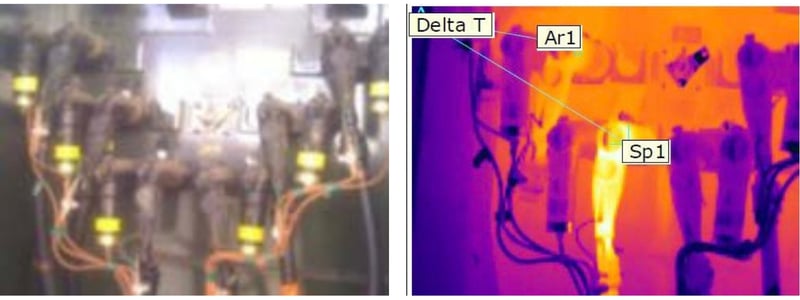
A side bushing — a comparison of conventional photography and a thermal image showing a Delta of 19.3°C between Sp1 (46.3°C) and Ar1 (27.0°C).
DGA Confirms the IR Finding
Cross-referencing the IR finding against the concurrent DGA results produced a critical confirmation. The dielectric liquid showed elevated levels of both ethylene and acetylene — gas species associated with high-temperature thermal faults and, in the case of acetylene, with arcing or very high localized temperatures. The presence of both gases in elevated concentrations was consistent with the thermal anomaly identified in the IR scan, indicating that the heat detected externally was likely affecting the internal connection as well. SDMyers recommended monitoring the loadbreak connection and bushing at the next scheduled inspection interval.
Persistent Hot Spot Triggers Replacement Decision
At the following year’s inspection, IR thermography showed that the hot spot had not resolved. The thermal anomaly on the A-side loadbreak persisted, and dissolved gas levels remained elevated. A hot spot that does not diminish — or that holds steady at elevated levels over consecutive monitoring intervals — indicates that the underlying fault condition has not self-corrected and is unlikely to do so. With two consecutive years of corroborating IR and DGA data documenting the progression, the findings provided the evidentiary basis for a more consequential asset decision.
Outcome: Planned Replacement Avoids Safety Incident
With a confirmed, persistent fault condition documented across multiple inspection cycles, SDMyers conducted a cost analysis comparing field repair of the connection against full transformer replacement. Given the asset’s age, the nature of the fault, and the operational criticality of the installation, replacement emerged as the more defensible long-term solution. Field repair of a high-voltage connection fault of this type carries execution risk and does not address the broader condition of the asset; replacement offered a more reliable resolution with a known service life going forward.
While planning and procurement were underway, SDMyers continued performing both liquid sampling and IR scanning at defined intervals to monitor the loadbreak and bushing condition. Ongoing monitoring through the replacement planning period served two functions: it provided early warning if the fault condition accelerated, and it ensured that operations could continue safely within a defined risk envelope until the scheduled replacement was completed.
The combined diagnostic record — IR thermography, DGA results, and multi-year monitoring data — equipped the customer to act with confidence at each stage of the process:
- Fault detection beyond DGA’s scope — IR thermography surfaced a high-voltage connection deficiency that liquid sampling could not have identified, closing a meaningful gap in the customer’s fault detection coverage
- Safety risk identified and managed — A 19°C phase temperature differential on an energized high-voltage connection represents a potential safety hazard; early detection allowed the condition to be monitored and controlled rather than discovered at failure
- Unplanned downtime eliminated — By converting an undetected, developing fault into a documented, monitored condition, the customer was able to schedule replacement on their own timeline, avoiding the operational and financial consequences of an uncontrolled failure on a critical asset
This case reinforces a principle consistent across reliability-centered maintenance programs: the value of any diagnostic method is defined in part by what it cannot detect. Liquid sampling and DGA remain essential — and in this case, DGA provided critical confirmation of the IR finding. But thermography reaches fault modes and physical locations that oil analysis cannot evaluate. Used together, on a consistent inspection schedule, the two methods provide a level of diagnostic coverage that neither delivers alone.
Summary:
- Liquid testing and DGA do not evaluate external high-voltage connections — bushings, loadbreaks, and mechanical interfaces operate under significant stress and require a complementary inspection method to assess their condition.
- IR thermography identified a 19°C phase temperature differential — a thermal anomaly on the A-side loadbreak that was not visible during standard visual inspection, indicating a localized fault at the high-voltage connection.
- DGA confirmed the IR finding — elevated ethylene and acetylene levels in the dielectric liquid were consistent with the external thermal anomaly, indicating the fault was affecting the internal connection as well.
- A persistent hot spot across consecutive inspections drove the replacement decision — the hot spot did not resolve at the one-year follow-up, and sustained elevated gas levels supported a full cost analysis comparing field repair against transformer replacement.
- Replacement was selected over field repair — asset age, fault nature, and operational criticality made planned replacement the more defensible long-term solution.
- Ongoing monitoring bridged the gap to replacement — continued IR and liquid sampling during the planning and procurement period kept operations within a managed risk envelope until the scheduled replacement was completed.
- Three outcomes were achieved — expanded fault detection coverage beyond DGA, early identification and management of a potential safety hazard, and elimination of unplanned downtime through a scheduled replacement.
Add IR Scanning to Your Routine Inspections
SDMyers recommends IR scanning in conjunction with liquid testing and visual inspection on transformers and other electrical equipment to provide a comprehensive snapshot of your asset’s condition. Performed simultaneously with liquid sampling on energized equipment with minimal disruption, IR scanning can provide a substantially clearer understanding of potential failure modes.
Contact us to learn more and partner with the experts in end-to-end transformer care since 1965.