


When Should You Test for Furanic Compounds in Transformer Oil?
- Knowledge Center
- Articles
- Furanic Compounds
- When Should You Test for Furanic Compounds in Transformer Oil?
This is Part 3 of a seven-part series on furanic compounds in transformers. Part 2 addressed which compounds we test for and what their presence tells us. Here we will cover when to run a furans test and how to act on the results. In Part 4, we will look at situations where it makes sense to run furans as a routine test.
Testing When a Problem Is Suspected
The most important time to test for furanic compounds is when you suspect a problem that the testing can help confirm and help resolve. While knowing the condition of the solid insulation is critical for any transformer, it may not always be the best use of resources to run furans as a routine test. Understanding when it is most valuable to analyze the insulating liquid for furanic compounds helps prioritize testing where it matters most.
Using DGA Results to Trigger Furans Testing
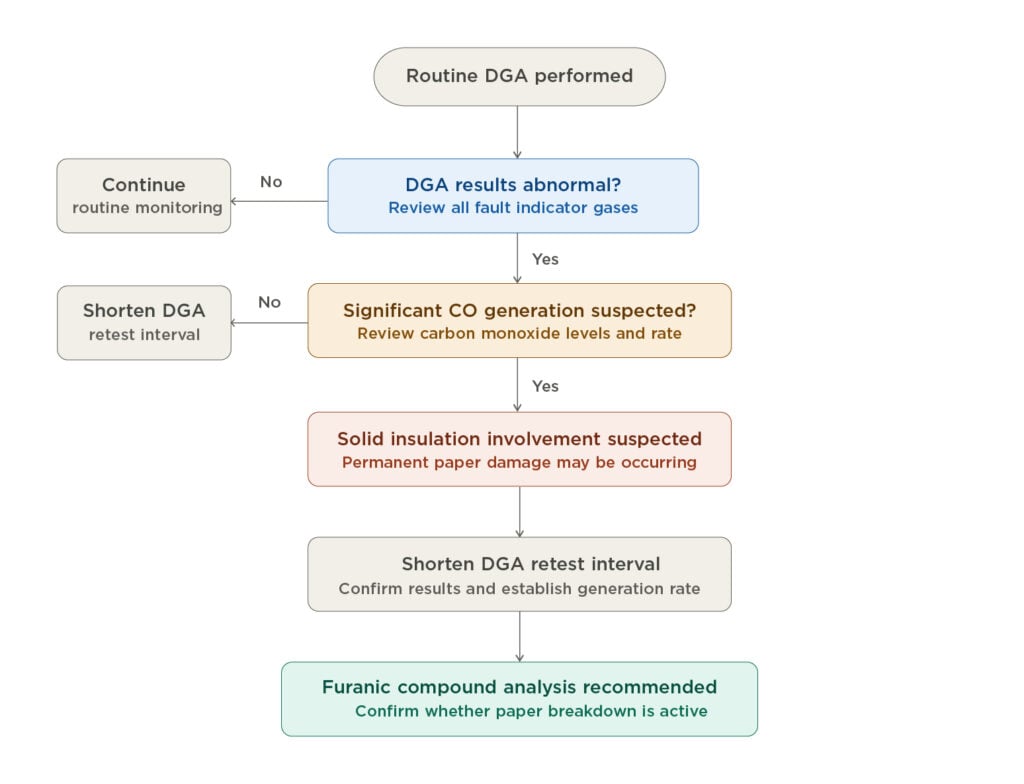
If a dissolved gas analysis returns abnormal results — particularly a significant quantity of carbon monoxide — this may indicate an incipient fault condition involving breakdown of the solid insulation. The standard next step is closer monitoring: a shorter-than-normal retest interval for DGA to confirm the abnormal results and establish a rate of generation for the combustible gases.
This becomes a higher priority when the fault involves solid insulation, because permanent damage to the paper is occurring and transformer life is being consumed. When significant carbon monoxide generation is suspected, furanic compound analysis is recommended to determine whether paper breakdown is actively taking place.
Why a Baseline Matters
Although furan results can be interpreted without historical data, having a baseline allows for a more reliable determination of active solid insulation degradation. Comparing current results to a baseline makes it possible to evaluate increases across all five furanic compounds — and eliminates the ambiguity that a 2FAL-only result can introduce.
Monitoring Furan Generation Over Time
Just as combustible gas generation rates are tracked in DGA, it is frequently appropriate to monitor furanic compound generation more closely as well. Active conditions causing paper breakdown may not be consistent or continuous. Closer monitoring of both gases and furans can provide valuable information for identifying a permanent solution to the conditions adversely affecting transformer operation.
Three Key Testing Scenarios
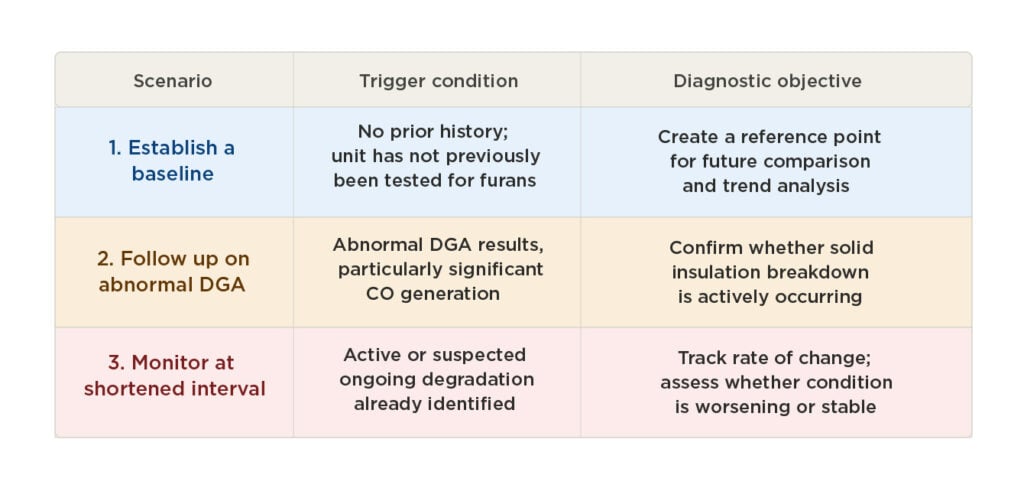
Three situations call for furanic compound analysis of the insulating liquid:
- Establish a baseline. Test to obtain an initial furans result to use as a diagnostic reference when abnormal conditions are later suspected.
- Follow up on abnormal DGA results. When dissolved gas analysis indicates a possible fault condition involving solid insulation, furans testing can confirm whether paper breakdown is occurring.
- Monitor at a shorter interval. When active degradation is suspected, retest furans at a reduced interval to track how concentrations are changing and assess the rate and conditions of solid insulation breakdown.
Summary:
- The most critical time to test for furanic compounds is when a problem is suspected — specifically, when DGA or other diagnostic results suggest a fault condition involving solid insulation breakdown.
- Abnormal DGA results, particularly significant carbon monoxide generation, are a primary trigger for furans testing. When solid insulation involvement is suspected, furanic compound analysis confirms whether paper breakdown is actively occurring.
- Baseline data improves diagnostic reliability. A prior furans result eliminates the ambiguity of a 2FAL-only finding and allows increases across all five compounds to be evaluated against a known reference point.
- Three scenarios justify furanic compound testing:
- Establish a baseline for use as a diagnostic reference when abnormal conditions are later suspected
- Follow up on abnormal DGA results to confirm whether solid insulation breakdown is occurring
- Monitor at a shortened interval when active degradation is suspected, to track concentration changes and assess the rate of breakdown
In This Series:
- Part 1: What Are Furanic Compounds and How Do They Form in Transformers?
- Part 2: How Do Furanic Compounds Indicate Active Paper Degradation in Transformers?
- Part 3: When Should You Test for Furanic Compounds in Transformer Oil?
- Part 4: When Should Furanic Compound Testing Be Routine?
- Part 5: What Furanic Compound Levels Are Diagnostically Significant?
- Part 6: How Are DP and Insulation Life Estimated from Furans Data?
- Part 7: How Does Oil Processing Affect Furanic Compound Results?