


How Do Furanic Compounds Indicate Active Paper Degradation in Transformers?
- Knowledge Center
- Articles
- Furanic Compounds
- How Do Furanic Compounds Indicate Active Paper Degradation in Transformers?
This is Part 2 of a seven-part series on furanic compounds in transformers. Part 1 covered how furanic compounds form in transformers as solid insulation breaks down. Here we look at which compounds we test for and what their presence tells us — not just whether paper degradation has occurred, but whether it is still occurring. Part 3 will cover when to run a furans test and how to act on the results.
The Five Furanic Compounds
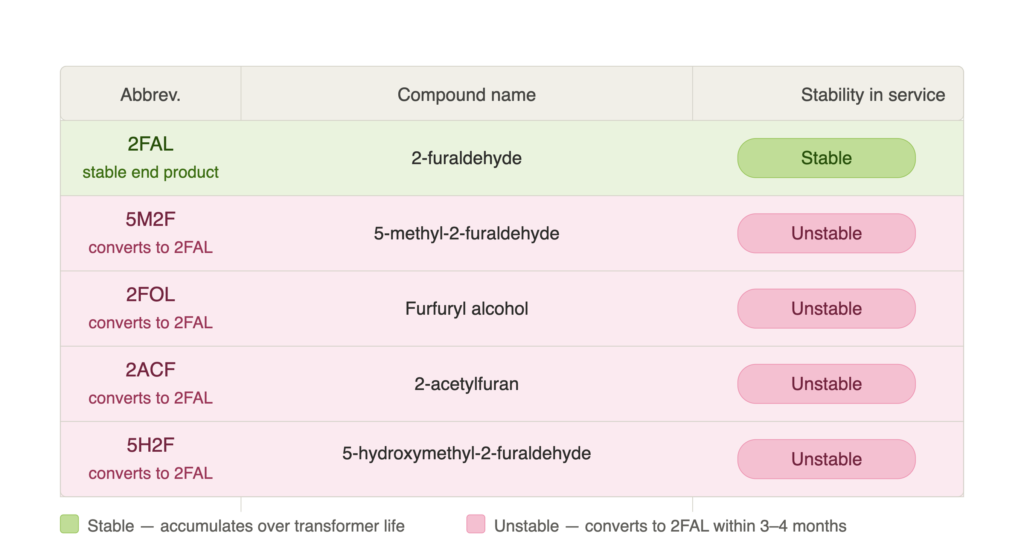
We test for five furanic compounds in insulating liquids. Increases in their concentrations indicate that paper is breaking down. Beyond that, the specific compounds present can identify what conditions caused the degradation — and whether those conditions are still active.
Interpreting Compound-Specific Results
Four of the five furanic compounds are unstable in an operating transformer. After forming, they begin to break down — and as they do, they convert into 2-furaldehyde (2FAL). This behavior is diagnostically useful.
The 3–4 Month Breakdown Window
In a normally operating transformer, all unstable furanic compounds break down to 2FAL within 3–4 months. This means that if a furans test detects any compound other than 2FAL, the condition causing paper degradation is either still active or was active within the past 3–4 months.
The Limitations of 2FAL-Only Results
If 2FAL is the only compound present, it is not possible to determine from a single test whether the degrading condition is still active. Mild or general overheating produces 2FAL, but so does the natural breakdown of the other four compounds over time. A retest after several weeks or months is needed to assess whether concentrations are rising.
Active Degradation vs. Historical Damage
The presence of unstable furanic compounds points to active or recent degradation. 2FAL alone indicates degradation has occurred but cannot confirm its current status without trend data.
Summary:
- Five furanic compounds are tested in insulating liquids. Increases in concentration indicate paper breakdown; the specific compounds present identify whether the degrading condition is still active.
- Four of the five compounds are unstable and convert to 2-furaldehyde (2FAL) over time. In a normally operating transformer, this conversion completes within 3–4 months.
- The presence of any compound other than 2FAL indicates an active or recent degradation condition — one that is either ongoing or was active within the past 3–4 months.
- 2FAL alone cannot confirm whether degradation is still occurring. Because 2FAL is produced both by active overheating and by the natural breakdown of the other four compounds, a single 2FAL-only result requires follow-up testing to establish whether concentrations are rising.
In This Series:
- Part 1: What Are Furanic Compounds and How Do They Form in Transformers?
- Part 2: How Do Furanic Compounds Indicate Active Paper Degradation in Transformers?
- Part 3: When Should You Test for Furanic Compounds in Transformer Oil?
- Part 4: When Should Furanic Compound Testing Be Routine?
- Part 5: What Furanic Compound Levels Are Diagnostically Significant?
- Part 6: How Are DP and Insulation Life Estimated from Furans Data?
- Part 7: How Does Oil Processing Affect Furanic Compound Results?